
If every health plan is ‘member first,’ what actually makes yours different?
Health insurance companies spend millions building their brands, yet many end up saying the exact same things. “Member first.” “Personalized care.” “Trusted partner.” These aren’t bad messages. They’re simply no longer differentiators. In an industry where products are often similar, the brands that stand out aren’t the ones making louder promises. They’re the ones creating experiences people actually remember.
Let’s look beyond the buzzwords and uncover what truly differentiates a health insurance brand. Let’s keep reading.
What they’re up against
Today’s health plan brands aren’t just competing with each other. They’re competing with complexity, frustration, and low trust.
The Data Shows the Uphill Climb every health insurance company faces
-
Trust is the foundation of every relationship. For an industry built around people’s health, earning trust may be the biggest opportunity to truly stand apart.
-
From claims to provider networks to prior authorization, coverage challenges shape how members feel about your brand.
-
When coverage is hard to understand, consumers can’t make confident decisions and the differences between health plans get lost in the confusion.
-
Prior authorization can turn accessing care into a frustrating experience, shaping how members see and trust your brand.
The Big Idea
Most health insurance companies are trying to solve the same business problem:
How do we convince people we’re different?
Ironically, they all answer that question exactly the same way.
When every company uses the same language, the brand begins to disappear. Messages about putting members first, delivering personalized experiences, and improving health outcomes start to blend together. What remains is a collection of interchangeable promises that could belong to almost anyone. The challenge isn't that these messages aren't meaningful. It's that they no longer give people a clear reason to remember one brand over another.
Visit almost any health insurers website and you’ll see some version of:
We’re member first.
We improve health outcomes.
We provide affordable care.
We deliver personalized experiences.
We’re your trusted healthcare partner.
None of those statements are wrong.
They’re just not unique.
Why This Happens
So how did an industry filled with different organizations, capabilities, and ideas end up sounding so similar? It didn't happen overnight. A combination of regulation, competition, risk, and internal pressures has gradually pushed health insurance brands toward the same familiar language.
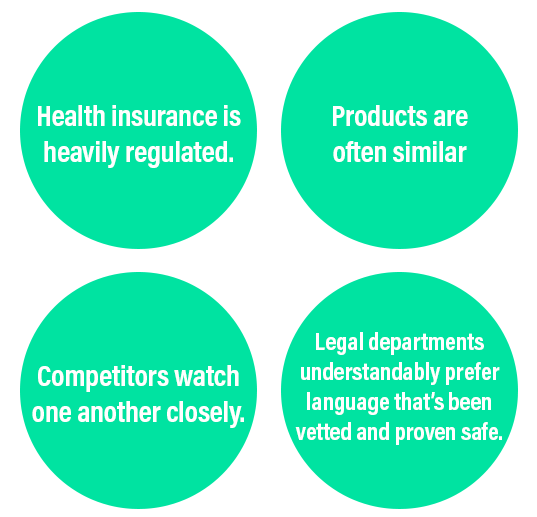
The result isn’t bad marketing. It’s a lack of meaningful differentiation. Over time, brands begin borrowing the same words, the same imagery, and the same positioning until the entire industry starts sounding alike.
The Real Problem
The real problem isn’t that health insurance brands don’t have anything meaningful to offer. It’s that those differences often get lost in a sea of similar messaging. When every plan promises affordability, personalization, and better outcomes, consumers are left with little reason to see one brand as meaningfully different from another. The challenge isn’t simply getting noticed. It’s giving people something distinct to remember.
Most members can’t explain the differences between plans
Employers often compare spreadsheets
Brokers evaluate benefits
Consumers compare premiums
Very few people choose a health plan because of a slogan.
They choose based on how much they trust the organization behind it.
That’s where branding becomes a competitive advantage.
Trust in the organization behind the plan is what truly drives the direction.
Where Differentiation Begins
Standing out starts by looking beyond the language everyone else is using and uncovering what makes your organization genuinely different. At Brillynt Studios, our approach begins by digging deeper into the brand, the business, and the experiences behind it. We look for the ideas, strengths, and stories that only your organization can credibly own, then turn them into a brand people can recognize, understand, and remember.
Instead of asking,
“What do we want people to know?”
Organizations should ask,
“What do we want people to feel?”
Emotions define the brand far more than any advertising campaign.
Marketing can’t manufacture differentiation. It can uncover it.
The strongest healthcare brands don’t invent a story or create promises the organization can’t deliver. They identify what’s genuinely different about the organization, uncover the value behind it, and communicate it in a way that feels clear, relevant, and authentic. Then they express that difference consistently, across every message, interaction, and experience that shapes how people see the brand.
That difference might be:
An exceptional customer experience
A culture built around service
Faster problem resolution
Stronger community relationships
Innovative care models
Remarkable simplicity
The job isn’t to sound better than competitors. It’s to sound unmistakably like yourself.
Take the Brillynt Idea With You
Want more? Download the free PDF for a deeper look at the topic, with additional insights and practical takeaways you can use.
Ready to Think Brillynt?
Have a brand, marketing, or creative challenge of your own? See how Brillynt Studios can help turn smart thinking into meaningful results.